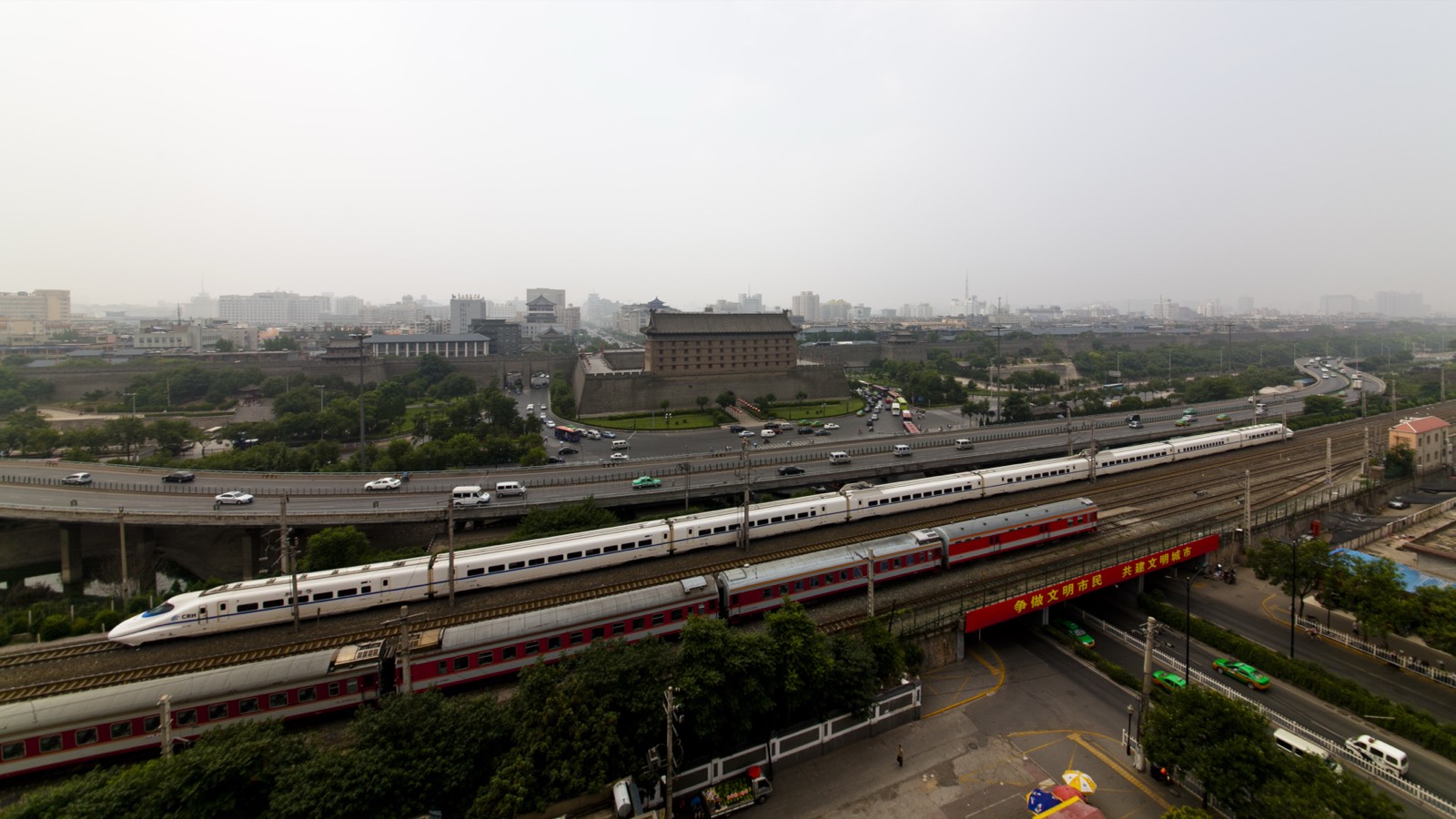
High-Speed Rail & Getting Around
48,000 km of high-speed rail at up to 350 km/h. For any journey under about five hours it beats flying, and your passport is the ticket.
Photo: Jucember · CC BY-SA 3.0
China built the largest high-speed rail network in the world from a standing start in 2008, and it has changed how the country travels. Trains are punctual to the minute, city-centre to city-centre, run every fifteen minutes on trunk routes, and cost roughly ¥0.45 per kilometre in second class. Once you have used it, domestic flying feels like a mistake.
The trunk routes
| Route | Fastest time | 2nd class fare |
|---|---|---|
| Beijing – Shanghai | 4h 18m | ¥553 |
| Beijing – Xi'an | 4h 26m | ¥515 |
| Beijing – Guangzhou | 7h 15m | ¥862 |
| Shanghai – Hangzhou | 45m | ¥73 |
| Shanghai – Suzhou | 25m | ¥40 |
| Shanghai – Xi'an | 6h | ¥671 |
| Xi'an – Chengdu | 3h | ¥263 |
| Chengdu – Chongqing | 1h 10m | ¥154 |
| Guangzhou – Guilin | 2h 40m | ¥217 |
| Hong Kong – Guangzhou | 50m | HK$247 |
| Lanzhou – Dunhuang | 4h | ¥260 |
| Xining – Lhasa (conventional) | 21h | ¥495 hard sleeper |
Classes and what to book
- Second class (二等座): 3+2 seating, ample legroom, power sockets, tray tables. Comfortable and what almost everyone should book.
- First class (一等座): 2+2 seating, wider, quieter, about 60% more. Worth it on journeys over five hours.
- Business class (商务座): 2+1 lie-flat seats, meal included, roughly triple second class. A genuine luxury on the Beijing–Shanghai run.
- Sleepers: on conventional long-distance trains. Soft sleeper is four berths in a lockable compartment; hard sleeper is six open berths and is perfectly civilised.
Booking
Two routes. Trip.com's international app is in English, takes foreign cards, and adds a small booking fee — the default for most visitors. The official 12306 app is cheaper and now has an English mode, but registration with a foreign passport can be fiddly and payment sometimes rejects foreign cards. Either way you book with your passport number, and the passport itself becomes your ticket.
- Book earlyTickets release 15 days ahead. Popular routes and any date near a holiday sell out. Off-peak, same-day is usually fine.
- Arrive 40 minutes earlyStations are enormous and airport-like, with security screening at the entrance and a separate ID check.
- Use the foreign passport laneAutomatic gates read Chinese ID cards only. Look for the staffed gate at the end — show your passport, it is scanned, you go through.
- Find your waiting areaDeparture boards list your train and a gate number. Boarding opens 15 minutes before and closes 3–5 minutes before departure, firmly.
Flying
Worth it only for genuinely long hops — Beijing to Kunming, Shanghai to Urumqi, anywhere to Lhasa or Jiuzhaigou. Chinese domestic flights have a poor punctuality record, particularly out of Beijing and Shanghai in summer, and airport transfer times often erase the notional saving. Book through Trip.com or the airline directly; Ctrip's Chinese app frequently shows cheaper fares.
In the city
| Mode | How | Cost |
|---|---|---|
| Metro | QR code in Alipay's Transport mini-program, or buy a single-journey token | ¥3–10, and there is a metro in every city you will visit |
| Didi | In-app, in English, or through the Alipay mini-program. Pays automatically | ¥20–45 across a city; the default for taxis |
| Street taxi | Flag down; show your destination in Chinese characters | Similar to Didi. Insist on the meter |
| Shared bikes | Hellobike and Meituan via Alipay or WeChat, unlocked by QR | ¥1.5 per 30 minutes. Excellent in flat cities |
| Buses | Same QR as the metro in most cities | ¥2 flat. Slow but scenic |
Driving
Don't. Foreign licences and International Driving Permits are not valid in mainland China; you need a temporary Chinese licence, obtainable at some airports for short stays. Combined with the traffic culture, the signage and the parking, it is not a sensible use of your holiday. Hiring a car with a driver, at ¥500–900 a day, is common, cheap and the right answer for rural areas.
→Next guide
Where to Stay
Chinese domestic hotel chains are modern, cheap and excellent — but not every hotel can legally accept a foreign guest, and that catches people out.