Mogao Caves & Dunhuang
莫高窟与敦煌 · Mògāo Kū & Dūnhuáng
Four hundred and ninety-two painted caves in a desert cliff — a thousand years of Buddhist art, sealed and forgotten for nine centuries.
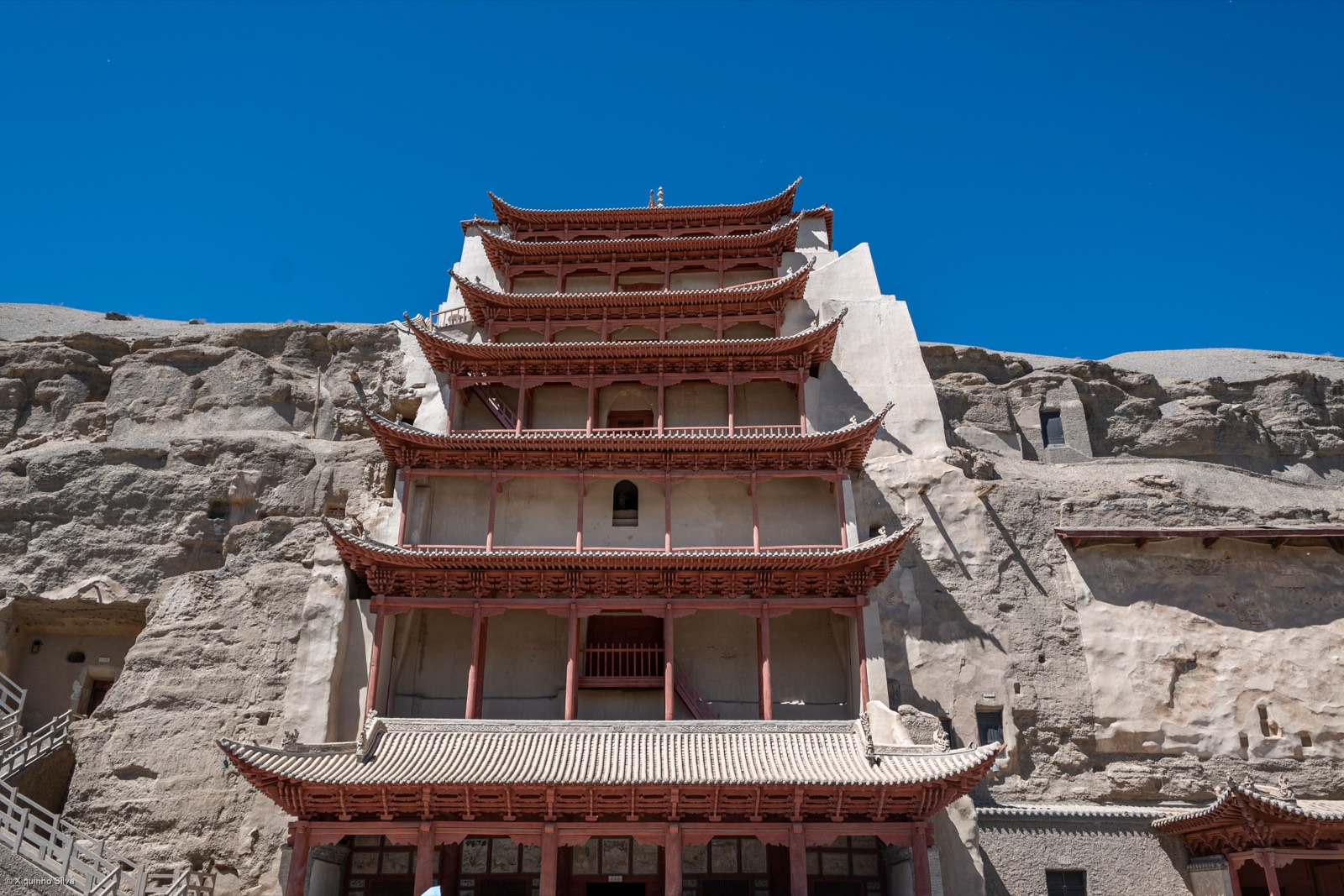
Photo: xiquinhosilva · CC BY 2.0
Dunhuang was the last Chinese town before the Taklamakan, the point where the Silk Road split north and south around the desert, and for a thousand years everyone going either way passed through. Merchants commissioned caves in a cliff outside town as merit-making before or after crossing, and monks painted them. Between 366 and roughly 1400 they cut 735 caves, of which 492 are painted, covering 45,000 square metres of murals and holding 2,400 painted clay sculptures.
The art traces the whole arc: Indian and Central Asian styles in the Northern Liang and Wei caves, the confident full-bodied Tang work of the eighth century, the more decorative Song and Yuan. The Tang caves in particular contain some of the greatest paintings produced anywhere in the medieval world — Pure Land paradises covering entire walls, flying apsaras, and donor portraits that are effectively fashion documentation.
Then there is the Library Cave. In 1900 a Daoist caretaker named Wang Yuanlu broke through a wall and found a sealed chamber packed with some 50,000 manuscripts, paintings and textiles walled up around 1000 AD — Chinese, Tibetan, Sanskrit, Sogdian, Uyghur, Hebrew — including the Diamond Sutra of 868, the oldest dated printed book in the world. Over the following decade Aurel Stein, Paul Pelliot and others bought the bulk of it for very little and shipped it to London, Paris, St Petersburg and Tokyo, where most of it remains. The cave itself is a small empty room and it is the most loaded empty room in China.
Why go
- One of the greatest collections of art anywhere on earth, and it is not a museum — it is in situ
- Serious conservation-led visitor management that actually works
- Crescent Lake and the singing sand dunes, ten minutes from town
- The whole Hexi Corridor — Jiayuguan, Zhangye — strings together on one rail line
Highlights
The standard cave tour
Eight caves, chosen and rotated by the conservation team, with a guide and a torch. Which eight you get is luck; all of them are extraordinary.
Cave 96 — the Nine-Storey Pagoda
The landmark timber facade on the cliff, sheltering a 35.5 m Tang Maitreya carved from the rock. Always included.
Cave 17 — the Library Cave
A small side-chamber off Cave 16. Empty since 1907. Stand in it and think about the 50,000 manuscripts.
Digital Exhibition Centre
Two films — a dome projection of caves you will not enter — shown before the shuttle to the cliff. Mandatory and genuinely excellent.
Mingsha Shan & Crescent Lake
Singing sand dunes up to 250 m with a spring-fed crescent lake at their foot, unfilled for two millennia. Camel rides, sandboards, and a superb sunset.
Yumen Pass & the Han Wall
90 km out into the Gobi: a lone Han-dynasty customs fort and 2,000-year-old rammed-earth wall, plus the Yardang badlands beyond.
Photographs
Getting there & practicalities
Getting there
Dunhuang has an airport (flights from Xi'an, Lanzhou, Beijing) and a station on the Lanzhou–Xinjiang high-speed line — 4h from Lanzhou, 12h from Xi'an. The caves are 25 km from town; all tickets include the shuttle from the Digital Centre.
Tickets
Full-price ticket ¥238 (8 caves + two films), released 30 days ahead online at the official site and it does sell out in July–August. An emergency same-day ticket at ¥100 shows only 4 caves and no films.
Opening hours
Digital Centre from 08:00; last tour departure around 16:00. Closed on some winter days.
Best time of day
May–June and September–October. July–August is hot (40°C) and fully booked; winter is cold but quiet and the light is beautiful.
What everyone gets wrong
- Book the full ¥238 ticket 30 days out. This is the single most important booking of a northwest China trip.
- No photography inside the caves, at all. Do not argue with the guides — the pigments are light-sensitive and the rule is absolute.
- Ask for an English-language tour when booking; they run but are limited in number.
- The Dunhuang Academy runs extra special-cave visits (¥150–200 each) for caves not on the standard rotation. Worth it if you are serious.
- Bring a torch anyway; the caves are unlit except for the guide's light and your eyes take a while to adjust.
What to eat
- Dunhuang donkey meat 'yellow noodles' (huangmian) — the local speciality
- Night market lamb skewers and apricot juice; and the region's outstanding melons and grapes in summer
→Combine it with
Nearby and next
 UNESCO
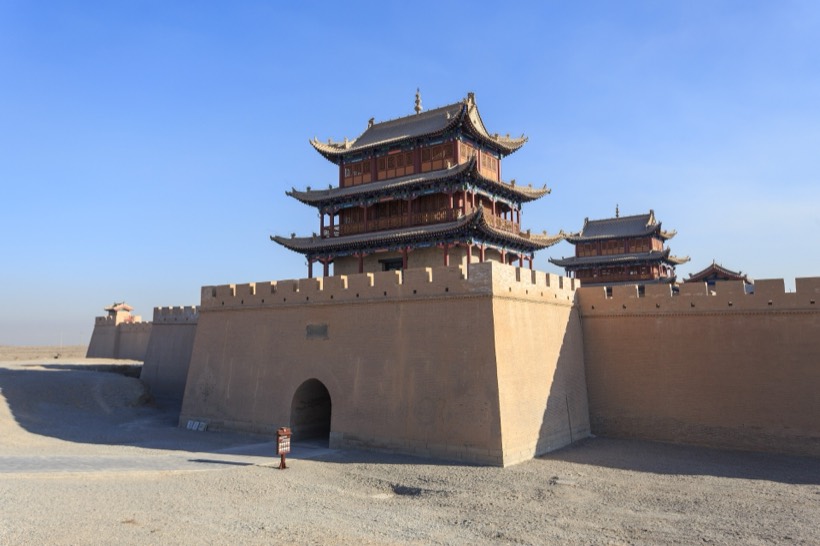
Jiayuguan Fort 嘉峪关
Where the Great Wall ends: a Ming fortress in the desert, between a snow range and the Gobi, that marked the edge of the civilised world.
 UNESCO
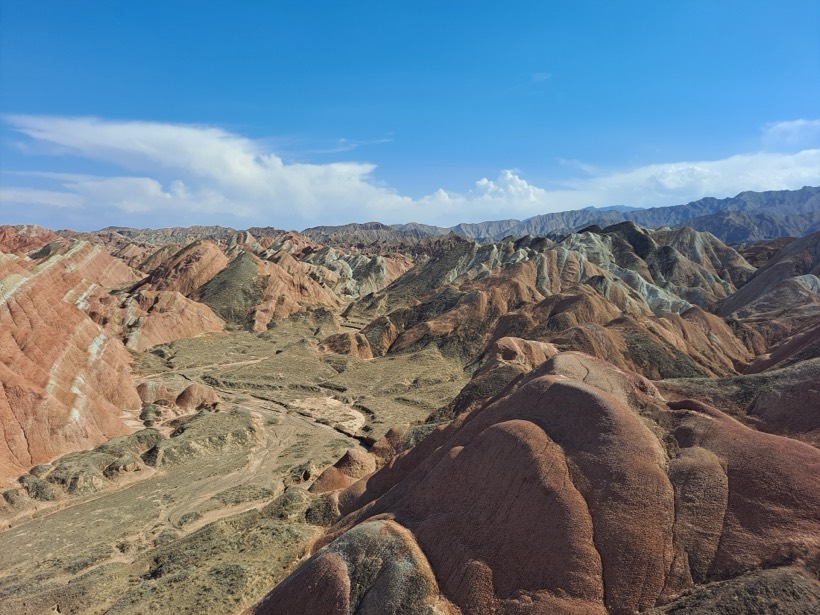
Zhangye Danxia 张掖丹霞
Hills striped in red, orange, yellow and green — twenty-four million years of mineral sediment tilted on its side.
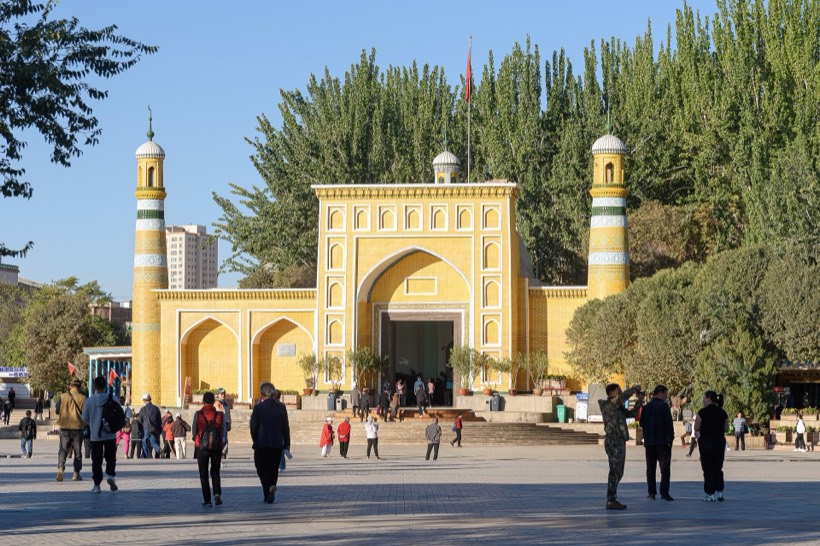
Kashgar 喀什
Closer to Baghdad than to Beijing: a Uyghur oasis city where the Karakoram, Pamir and Tian Shan ranges meet.